
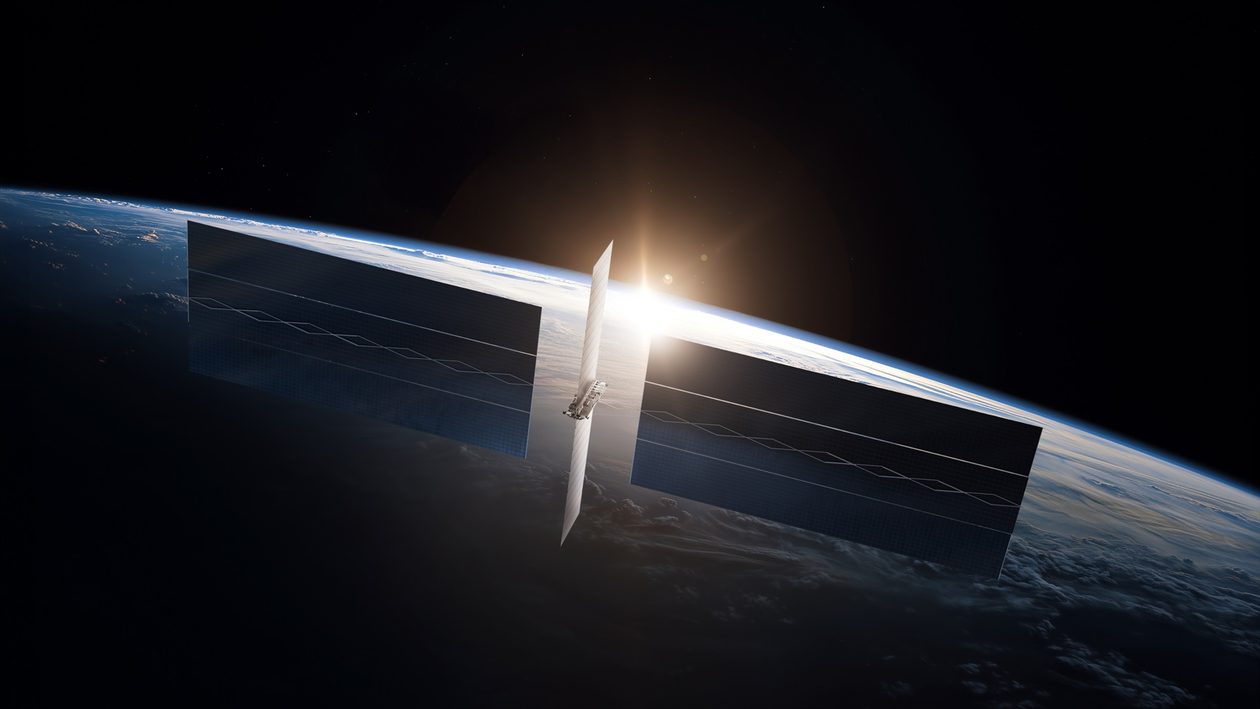
Data centers are running out of easy places to go on Earth. They need enormous amounts of power, land, and cooling, and communities are increasingly pushing back against building more of them. On Wednesday, November 25, 2026, the Federal Communications Commission gave SpaceX permission to try a radically different address: orbit. The agency authorized SpaceX to deploy and operate up to 1 million satellites for Starmind, a constellation of orbital compute modules designed to process data for artificial intelligence workloads back on Earth. The FCC called it the first authorization in U.S. history for a constellation of data centers in space.
What Starmind actually is
Starmind is not another internet service. Each satellite is meant to work as a small piece of a much larger computer, powered by sunlight in space and linked to its neighbors so the group can handle demanding AI jobs together. SpaceX filed its application on January 30, 2026, arguing that putting compute in orbit is an efficient way to meet fast-growing demand for AI processing without drawing the same power and water that a ground-based facility would.
The scale is difficult to overstate. SpaceX already operates the largest satellite fleet in orbit, Starlink, at roughly 11,200 spacecraft. Starmind at full size would be nearly ninety times that. Its first-generation spacecraft, AI1, has a wingspan of 75 meters (246 feet) and a deployed height of 30 meters (98 feet), built in partnership with Nvidia and carrying Nvidia Rubin GPUs and Vera CPUs. SpaceX plans to build them in Bastrop, Texas, and launch them on Starship.
The terms the FCC set
This was a conditional, partial approval, not a blank check. The FCC cleared Starmind satellites to operate in orbital shells spanning 50 kilometers, at altitudes from 500 to 1,002 kilometers (about 310 to 623 miles), in 30-degree and sun-synchronous inclinations. The satellites will communicate primarily over optical — laser — links, including links into the Starlink network. Radio frequencies are approved only as a backup: Ka-band spectrum at 18.8–19.3 GHz for space-to-Earth and 28.6–29.1 GHz for Earth-to-space, limited to telemetry, tracking, and command if the optical links fail.
The deployment clock is long but binding. SpaceX must put its first authorized satellite into operation by November 25, 2033, reach 100,000 satellites — 10 percent of the constellation — by November 25, 2035, hit 50 percent by November 25, 2038, and complete all 1 million by November 25, 2040, or the authorization becomes void. That said, SpaceX says it intends to move far faster: Elon Musk has said he expects the first Starmind spacecraft to launch in the third quarter of 2027, with volume ramping up in 2028 and growing much larger in 2029.
One major piece was left unresolved. The FCC deferred SpaceX’s request to dispose of satellites above 600 kilometers in graveyard or heliocentric orbits instead of by atmospheric re-entry, saying SpaceX had not provided enough information to show that complies with its rules. SpaceX will have to apply for a modification before using that approach.
Approved over strong objections
The decision came despite formal petitions to deny it from Amazon’s Kuiper Systems (now Amazon Leo), satellite operator Viasat, and the American Astronomical Society. Opponents raised concerns about orbital debris and congestion, radio-frequency interference, and the effect a million bright objects could have on astronomy and the night sky. Amazon argued the application lacked basic detail and risked real harm. The FCC rejected those petitions, finding that the limited backup-only use of radio spectrum addressed the interference concerns, and it treated the optical astronomy concerns as outside the scope of its radio-frequency authority.
The Astronomical Society said it was disheartened and dismayed, warning the constellation could undermine decades of federal investment in astronomical facilities. FCC Chairman Brendan Carr took the opposite view, calling data centers essential to America’s leadership in AI. Musk thanked Carr publicly, calling the authorization a great asset to America and the world.
The hard problems that remain
Approval is not the same as feasibility. Cooling processors in a vacuum is a genuine physics problem, because heat in space can only leave a satellite by radiation. Building and launching anything close to a million large satellites will require Starship flying routinely at a scale it has not yet reached, plus a huge supply of advanced AI chips to send into orbit. Critics remain openly skeptical the economics and engineering will close. The FCC is still reviewing other orbital data center proposals — including from Blue Origin, Google’s Project Suncatcher, and Starcloud — so SpaceX is first through the door, not the only one trying.
The bottom line
The FCC’s November 25 decision turns orbital data centers from a talking point into a licensed business, and it hands SpaceX an enormous head start: up to 1 million Starmind satellites, operating between 500 and 1,002 kilometers, with a full-deployment deadline of 2040. Nothing about the technology is proven at this scale yet, the disposal rules for the highest satellites are still unsettled, and astronomers are already objecting in the strongest terms. But the regulatory barrier — historically the first thing that stops an idea this big — has now been cleared. Whether Starmind becomes the future of AI computing or the most ambitious constellation that never filled up will be decided by launches, starting, if SpaceX holds its own schedule, in 2027.
Source: Federal Communications Commission authorization order for SpaceX’s Orbital Data Center System (Starmind), DA 26-1273, published November 25, 2026, with coverage from TechCrunch, Engadget, Reuters, GeekWire, and Spaceflight Now, published November 25–26, 2026. Featured image: SpaceX illustration of a Starmind satellite in orbit, via GeekWire.
Leave a Reply