
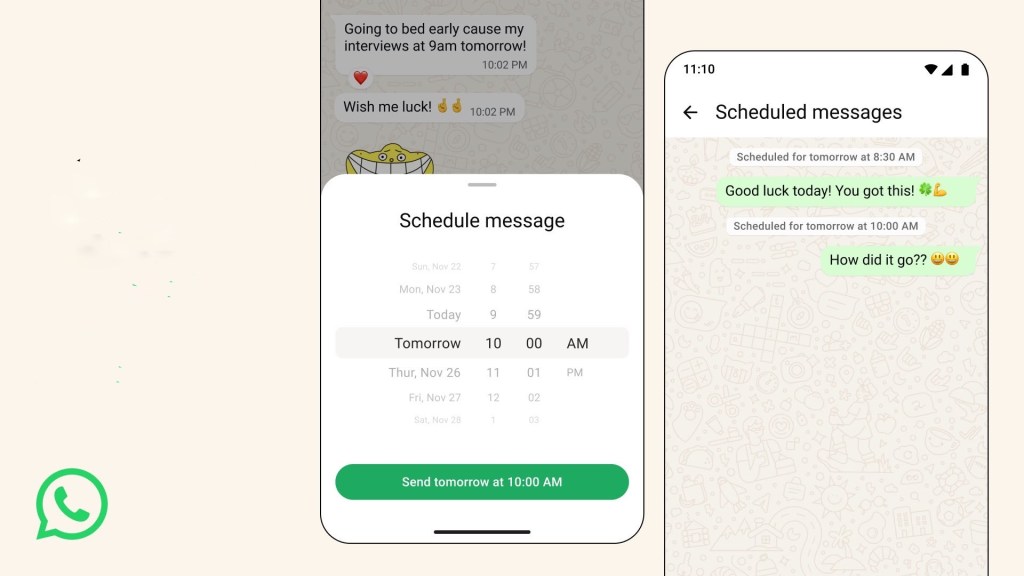
It is 11 p.m., you have just remembered a birthday, a rent reminder, or the one thing your group chat absolutely needs to hear at 8 a.m. — and you know that if you send it now, it will either wake somebody up or get buried before morning. WhatsApp has finally solved that problem. On Wednesday, November 25, 2026, WhatsApp began rolling out scheduled messages, a feature the company itself calls one of the most requested it has ever had. You write the message when you think of it, pick when it should land, and WhatsApp handles the rest.
How scheduling works
The feature is built into the chat screen you already use, so there is nothing new to learn and no separate app or workaround involved. Compose a message in any one-to-one chat or group chat, then press and hold the send button instead of tapping it. A picker appears, and you choose the date and time you want the message delivered.
You can schedule a message anywhere from 10 minutes to 14 days in the future. That window covers most real-world cases: the birthday wish that must arrive at midnight, the reminder a coworker in another time zone should see when their workday starts, or the photo that should hit the family group chat on the morning of an event rather than the night before.
WhatsApp also lets you review everything you have lined up. You can see all of your upcoming scheduled messages in one place and delete any of them before they go out if you change your mind. One open question, noted in early coverage, is whether you can edit a message’s text or timing after scheduling it — so far, deleting and starting over appears to be the safe assumption.
More than just text, and it sends even if your phone is off
Scheduling is not limited to plain text. You can schedule photos and videos as well, which makes it useful for everything from timed announcements to sending media at a moment when you know you will be busy, traveling, or asleep.
Two details make the implementation better than a simple phone-side timer. First, a scheduled message still goes out at the time you chose even if your phone is switched off or out of battery — delivery does not depend on your device being awake and online when the moment arrives. Second, scheduled messages keep WhatsApp’s end-to-end encryption, just like regular personal messages, so the content stays readable only by you and the people in the chat.
On the receiving end, there is nothing unusual at all. A scheduled message arrives looking like any other WhatsApp message, with no label telling the recipient it was written hours or days earlier. If you are the kind of person who composes thoughtful messages at 2 a.m. but has the good sense not to send them at 2 a.m., nobody will ever know.
Long overdue — the rivals have had this for years
If this sounds familiar, it should. Telegram and Signal have offered message scheduling for a long time, and it has been one of the most obvious gaps in WhatsApp’s feature list, especially for an app used by billions of people across every time zone on earth. For years, WhatsApp users who wanted the same trick had to rely on shortcuts, automation tools, or third-party apps — clumsy substitutes for something that should have been a long-press away.
The feature should land particularly well with small businesses and community organizers, who make up a huge share of WhatsApp’s everyday use. Being able to write an update when it is convenient and have it arrive when customers or group members are actually awake removes a lot of friction from running a group, a shop, or a team over chat.
When you will get it
WhatsApp says scheduled messages are rolling out globally over the coming weeks, on both iOS and Android, so the option may not appear on your account immediately. The practical advice is simple: install the latest WhatsApp update — a new version was released today alongside the announcement — and then try the long-press on the send button in a chat. If the scheduling picker shows up, you are in. If not, the rollout should reach you soon.
The bottom line
Scheduled messages will not change what WhatsApp is, but they fix one of its most annoying everyday gaps. The 10-minute-to-14-day window is generous, support for photos and videos makes it genuinely flexible, delivery works even with your phone off, and encryption stays intact. It is late — years late, compared with Telegram and Signal — but it is implemented the way users asked for: built into the send button, available in private and group chats alike, and invisible to the person receiving the message. Update the app, long-press send, and let future-you stop worrying about present-you forgetting.
Source: WhatsApp’s official blog announcement of scheduled messages (November 25, 2026), with coverage from TechCrunch, MacRumors, Engadget, and 9to5Mac, all published November 25, 2026. Featured image: WhatsApp, via TechCrunch.
Leave a Reply